Search
Project ambit: Transform a closed Government School into a modern educational facility
Project timeline: 180 Days
Project completion time: 100 days
The UAE has announced 2023 as the ‘Year of Sustainability’ as the country gears to host the Conference of Parties 28. The announcement has spurred the collective - industries, and private individuals into looking at reducing their carbon footprint in order to achieve the goal of Net-zero 2050. The built industry, which includes the entire supply chain - from urban planners, architects, developers to facilities managers, and asset managers are now under the spotlight to ensure reduction in greenhouse gas emissions and energy consumption. The built environment is responsible for 27% to 36% of greenhouse gas emissions, which mainly stem from construction, usage, renovation and demolition.
As per the UN Breakthrough Goals for the Built Environment it is imperative for the global property sector to halve emissions by 2030 and achieve Net-zero emissions by 2050 at the very latest.
Arup, a British building design, engineering & advisory firm explains, “Every aspect of construction produces a potential carbon impact, so identifying where the emissions enter the life cycle of construction is the only way to make a credible carbon accounting within the built environment. Whole Life Cycle (WLC) emissions result from the form, materials, construction methods, and operation of a building over its entire life, including its demolition and disposal.”
One of the ways to reduce the WLC in the built environment is to build less, and make existing buildings more efficient - operationally. According to a report on ‘Energy efficiency in buildings’ by the European Commission, renovating existing buildings could reduce the EU’s total energy consumption by 5-6% and lower carbon dioxide emissions by about 5%. Hence, increasing the efficiency of an existing facility is a priority and the EU wants to double the rate of renovations to meet its climate goals.
Increasing the efficiency of existing building stock can be done through multiple ways - renovation, refurbishment, and retrofit.
A renovation involves restoring the building to a good state of repair. This is the least invasive option out of the renovation, retrofit and rebuild options. A renovation typically involves making smaller fixes to a building that help to repair distress, increase efficiency and improve the aesthetic of the building.
The lifecycle of a building can be significantly extended by effective renovation and refurbishment, as such it is a key component in achieving a circular economy. As every building is unique, not only structurally, technically and typologically, but also in local context, the correct approach to renovation and refurbishment should be assessed according to the particular conditions.
Whenever a building is recycled, by opting for refurbishment rather than demolishing and rebuilding the structure then a large amount of energy is being saved by avoiding the need to extract raw materials and convert them into a replacement building. Smaller scale refurbishment, for example when the existing structure and the external building envelope are retained, will clearly yield the greatest energy savings, but even the more drastic renovations, where larger scale refurbishment combined with a retrofit takes place involving the structural aspects and the refurbishing of the outer leaf will mostly use up considerably less energy resources than the choice to demolish and rebuild.
Provis Real Estate and Property Management company was tasked with refurbishing a non-operating (closed) school facility in Abu Dhabi. The project entailed transforming the Al Qurm School, located in Mohamed Bin Zayed City, into a fully operational facility in time for the 2022-23 academic year. The built asset was spread over 5500 sq metres and the overall developed plot was spread over 14,00 sq metres. A project completion timeline of 180 days was agreed upon by the stakeholders. The plot included outdoor play areas, central courtyard, parking, student’s drop-off areas, and landscaping.
.jpg)
Provis said the decision to carry out a renovation project rather than a complete re-build or extensive refurbishment was made on the basis of the structural and a scope assessment report which underlined sound structural strength yet noted the need for extensive repair.
The school building was repaired, rejuvenated, and aesthetic changes made to bring it to proper working order. Upgrading the structure involved taking out old ceilings, replacing outdated electrical systems, and ripping up old flooring. These were replaced with vinyl flooring, instead of ceramic tiling. The renovation was done using green construction material, and fixtures used were the most energy efficient with utmost importance given to sustainability while renovating the school building infrastructure. While the bones of the built asset were upgraded keeping in mind energy efficiency, and green materials such as sustainable refrigerants, mixers that used up less water were part of the input material, the aesthetic was also of vital consideration as it was meant to be used by children for an extended period of time. The acoustics of the facility was enhanced to match modern schooling requirements and the corridors were upgraded to fully air-conditioned passages. The goal was to achieve a modern educational facility in every sense of the word.
.jpg)
Provis completed the project within a record 100 days, shaving off 80 days from the agreed upon timeline. This was done through strict adherence to project management standard operating procedures such as regular meetings to monitor progress, managing operational details through the use of technology – Primavera platform was used to execute the renovation project, and compliance with local government regulations. Provis said the project was chalked up as an accomplishment in terms of strategy, operational, and handover goals. Musbah Abujarad, Executive Director of Integrated Facilities Management, Handover and Sustainability at Provis explained, “Given the pandemic restrictions, we faced many challenges in completing the different phases of the project. These included the scope, development and approval process from the client, tendering and awarding to the construction contractor and the procurement of long lead items (furniture, flooring, play equipment, etc.), some of which had to be imported. However, we managed to hand over some phases of the project including the administration section to enable the school operators to access the space while other sections were being completed. We were also successful throughout the project to prioritise students’ safety in every aspect of the design and every material we used.”
The renovation of the Al Qurm School expanded the life expectancy of the existing built asset by 20 years through future-proof solutions. The new fixtures would ensure six per cent power saving through the use of sustainable material as well as managing the flow of movement through-out the built-up area. The renovation also kept in mind the seasonality of the use of facility – areas that would be used extensively during winter months versus summer months to manage the facility. The renovation project also included creating external shading areas, and adding access control to restrict the wastage of energy through exposure of air conditioned spaces. All these features added to reduced consumption of energy by the facility.
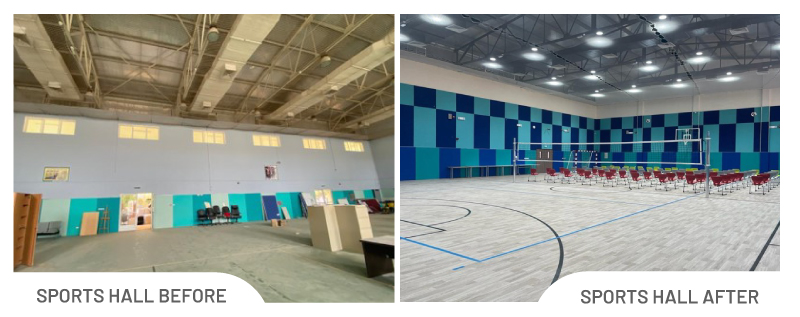
The facility was handed over in a completely fit-for-use state in 100 days since the start of the renovation project – a landmark achievement for Provis. The school is currently serving 750 Students in Grade 1 to 5. Looking back at the project post hand-over Abujarad said, “We learned a lot along the way, especially about in-depth scope assessment, involving and aligning all stakeholders around required documentation, and identifying risks, challenges and opportunities while remaining realistic and transparent with all parties. Keeping the stakeholders informed and using practical and efficient procurement and construction procedures and tactics to fulfill the deadlines proved to be essential in such a fast-paced project.”
This project serves as an example that renovation still tends to be greener than rebuilding, especially for waste reduction purposes as well as plays a vital part in the circular economy of the built environment.
Al Qurm School renovation circular economy built environment Provis Mohamed Bin Zayed City Whole Life Cycle (WLC) emission UN Breakthrough Goals Net-zero 2050 Conference of Parties 28 greenhouse gas emissions energy consumption urban planners architects developers renovation refurbishment retrofit global property sector