Search
.png "DOING MORE WITH LESS: Innovative technology and automation in FM and energy management")
In property management, business performance is increasingly reliant on technology. In FM, the implementation of new technologies is driving efficiencies and cutting operational costs, with significant developments being made in automation and energy management via AI and IoT- driven innovations.
Businesses across sectors are seeking to do more with less, leveraging technology to cut unnecessary tasks, reduce costs, and redeploy staff into value-add areas. This is leading to some amazing innovations currently entering the mainstream.
For example, in food and hospitality, the adoption of robotics has been making waves. Anyone looking for food delivery in Dubai Silicon Oasis can place their order online or via an app, and have it delivered within 15 minutes by a “Talabot” – an AI driven food delivery robot able to transport food orders within a range of 3km. Customers can follow the zero-emission delivery robot’s progress via an app, which leaves human employees to focus fully on enhancing the customer experience and dealing with any complex customer requirements. The technology allows human workers to do more of what they are good at, thereby providing an improved service to customers and boosting business performance.
While this kind of robotics in property management may be some way off, the same approach of automating tasks to focus human workers on more soft-skill-based duties is firmly taking hold in FM.
The Middle East is currently representing massive technology potential, thanks to rapid growth and fast construction. Demand from property managers for tech-delivered enhancements to operational efficiency is pushing innovation, as suppliers work to keep pace with client needs.
EVENTS-BASED MAINTENANCE
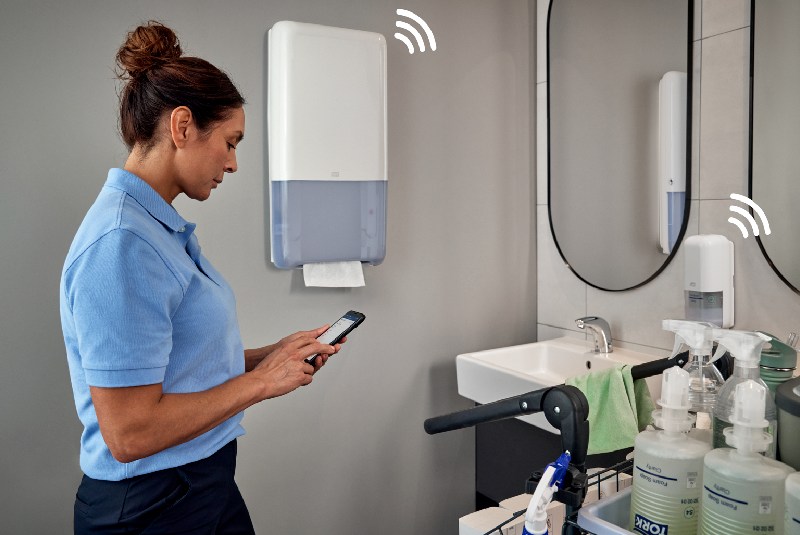
Sensors, as part of the Internet of Things, are not a new development. For a few years now, facilities managers have harvested data to monitor asset performance, but the full potential benefits of this are still being explored by developers. For example, if a temperature sensor indicates that a room is too hot, what can we do with that information other than simply send an alert? Recent innovations now mean that high level sensors raise a task in the connected FM solution, prompting a facilities manager to go investigate and resolve the issue.
But we can go further and incorporate other assets in the IoT to respond and ensure environments are maintained. For instance, a temperature sensor triggers an alert, which raises a task in the business’s FM solution. At the same time, a prompt is also sent to the building management system to adjust the heating in the affected area, to maintain a comfortable environment.
This model can be adapted for a range of situations.
For example, drip tray sensors can monitor fluid accumulation in drip trays or other containment areas, usually under appliances such as refrigerators, air conditioning units, or coffee machines. The sensors raise alerts when they need to be emptied, preventing leaks and water damage and freeing up time.
SENSOR-BASED OCCUPANCY TRACKING
A good case study of sensor and FM integration usage in practice is one of the MRI office buildings. We installed sensors to track and monitor footfall, dwell time in meeting rooms, and measure occupancy.
The sensor data offered insights into how efficient our building was and allowed us to track useful metrics. The combination of footfall tracking, presence management and energy usage data allowed us to measure energy per footfall, a powerful tool in managing energy efficiency and reaching ESG targets – important for attracting investors.
In reality, these systems were providing information that was already available, but presenting it in a relevant and actionable way. We could track who was on site, what impact their presence was having on the building (e.g., temperature, water usage etc.) and translate this into carbon footprint data.
So how do we use this data to reduce the carbon footprint of our buildings?
The key is through smart data analytics, identification of malfunctioning equipment, and automation.
In the example of MRI offices, by analysing the data, we identified a fault with our heating system. We noticed that the heating wasn’t shutting off over the weekend while the office was empty, racking up additional costs and increasing our carbon footprint unnecessarily. Through optimising our system, we can now track appliance performance, and identify any anomalous behaviours.
LEVERAGING DATA
With occupancy and footfall measurement, it’s a case of trend and pattern spotting. For example, at the MRI offices, majority of the teamwork based on a hybrid model, so the building occupancy is not consistent. Over several weeks of measuring occupancy and footfall, we identified which days were the busiest, and therefore times of highest utility consumption. However, on the quieter days, we could see that cuts could be made to energy consumption.
The offices comprise seven floors, and on the busiest days, most of the spaces are in use. However, on quieter days, we noticed that several desks, offices, communal areas and upper floors of the building don’t get used. We used this data to switch off the heating and lighting and cancel the cleaning services for the unoccupied spaces and floors. This provided us with immediate saving.
The same method is used on a more granular level with meeting rooms. Space management systems can inform temperature control and lighting requirements for meeting and conference rooms by providing data on booking times and duration, while footfall and occupancy tracking can verify this and provide information on occupancy levels and dwell time. Therefore, systems can be optimised to ensure that the meeting room environments are at comfortable levels when in use, and then be shut off while the rooms are unoccupied. For example, we can see when an 18-seat conference room has been booked for an hour, but in reality, only two people are present for 15 minutes. If the booking data alone triggered the building management system to run temperature control, it would have done so for an hour, which is unneeded and would lead to unnecessary energy usage and spend. But if sensor data is driving the building management system, the building can start to become self-governing, and adjust environmental controls in relation to real-time occupancy requirements.
In other industries, such as retail, building managers can track footfall and dwell time in various parts of a mall, or departments of a shop, and use this data to manage facilities management regimes. For example, cleaning schedules can be devised based on footfall in specific areas, instead of blanket cleaning schedules.
AI AND THE FUTURE OF AUTOMATED FM
In the future, with the implementation of machine learning, building systems can utilise algorithms to learn how the building is being used, and automation procedures can become more dependable. For example, a building can know a shop’s opening hours, and how much energy is needed in relation to footfall. It can therefore begin to make decisions based on when to turn on lights and HVAC systems, when to open additional entryways, and organise cleaning schedules based on this data.
With the emergence of increasingly sophisticated tech, we can optimise building performance, and therefore improve profit margins, as well as run more sustainable and environmentally responsible buildings. And moreover, while the tech is allowing us to do more with less, the humans in our businesses can focus on meeting staff and customer needs in ways that tech simply can’t do.